Governed, provable autonomous exposure validation

Find it. Prove it. Fix it.

EchoStrike watches your attack surface, proves what's exploitable with AI-driven attacks, and helps you fix it — continuously, not once a year. It starts with an autonomous pentest, and every finding carries the exact steps that proved it.

RedEngine — host risk mosaic
our risk ranking
3critical
7high
8medium
6low
db-01.example.com99
most serious finding
Default admin credentials active on management console
CriticalCVSS ~9.8
+1 awaiting triage
vpn.example.com94
most serious finding
NFS export exposes sensitive files (shadow, SSH keys, backups)
CriticalCVSS ~9.1
+3 awaiting triage
auth.example.com89
most serious finding
Authentication bypass via JWT algorithm confusion
CriticalCVSS ~9.0
+2 awaiting triage
dev.example.com78
most serious finding
End-of-life application stack exposed (PHP 5.5, Apache 2.4.7)
HighCVSS ~7.8
+2 awaiting triage
staging.example.com75
most serious finding
Directory listing enabled on internal file share
HighCVSS ~7.5
+1 awaiting triage
files.example.com72
most serious finding
SSRF chained to cloud metadata service — credentials exposed
HighCVSS ~7.4
+2 awaiting triage
portal.example.com69
most serious finding
Insecure deserialization in session handler
HighCVSS ~7.2
+1 awaiting triage
internal.example.com66
most serious finding
Path traversal exposes application source
HighCVSS ~7.0
+3 awaiting triage
gateway.example.com63
most serious finding
Outdated TLS cipher suite accepted (RC4)
HighCVSS ~6.8
+1 awaiting triage
legacy.example.com60
most serious finding
Unauthenticated API exposes internal employee records
HighCVSS ~6.5
+2 awaiting triage
mail.example.com58
most serious finding
Deprecated TLS 1.0 handshake still accepted
MediumCVSS ~5.9
+4 awaiting triage
cdn.example.com54
most serious finding
Cross-site scripting via unescaped status message
MediumCVSS ~5.4
+3 awaiting triage
status.example.com51
most serious finding
Verbose server banner discloses software version
MediumCVSS ~5.3
+2 awaiting triage
docs.example.com48
most serious finding
Missing rate limiting on password-reset endpoint
MediumCVSS ~5.0
+2 awaiting triage
cache.example.com45
most serious finding
Cacheable response exposes session token in URL
MediumCVSS ~4.8
+1 awaiting triage
media.example.com42
most serious finding
Insecure direct object reference on file download
MediumCVSS ~4.6
+2 awaiting triage
support.example.com39
most serious finding
Clickjacking — missing X-Frame-Options header
MediumCVSS ~4.3
+3 awaiting triage
assets.example.com36
most serious finding
Subresource integrity missing on third-party script
MediumCVSS ~4.0
+1 awaiting triage
api1.example.com24
most serious finding
Live host exposed behind a deny-all perimeter
LowCVSS ~2.6
none — informational
edge.example.com20
most serious finding
Verbose error message reveals stack trace
LowCVSS ~2.3
none — informational
beacon.example.com17
most serious finding
Self-signed TLS certificate on internal endpoint
LowCVSS ~2.1
none — informational
probe.example.com14
most serious finding
HTTP OPTIONS method enabled
LowCVSS ~1.8
none — informational
sensor.example.com11
most serious finding
Server banner discloses OS version
LowCVSS ~1.5
none — informational
ping.example.com7
most serious finding
ICMP echo reachable from external network
LowCVSS ~1.0
none — informational
critical high medium low
critical Exposed admin endpoint accepts unauthenticated requests
replicationcurl -s https://target/admin/api/status
output200 OK — internal build metadata returned
briefingAI-generated, routed to expert review
why echostrike

Attackers now move at machine speed. Annual testing doesn't.

AI has made attacks faster, cheaper and continuous. A pentest once a year leaves the other 364 days untested. EchoStrike closes that gap — not another scanner, but a system that proves what's exploitable, every day.

Watch the attack surface

Assets, exposures and leaked credentials are rediscovered continuously — not just at the start of an annual test window.

Prove the path, not just the flag

Every finding keeps the steps that demonstrated it, plus a map of what that route actually touches downstream.

Let each side do what it's good at

Automation carries the scale. People carry judgment — authorization calls, ambiguous evidence and decisions that should not be automated.

the platform

Find. Prove. Fix. One evidence chain.

Most tools stop at the finding. EchoStrike carries the same evidence from discovery, to a proven attack path, to a fix you can verify — one connected loop rather than disconnected tools.

find

ReconPulse

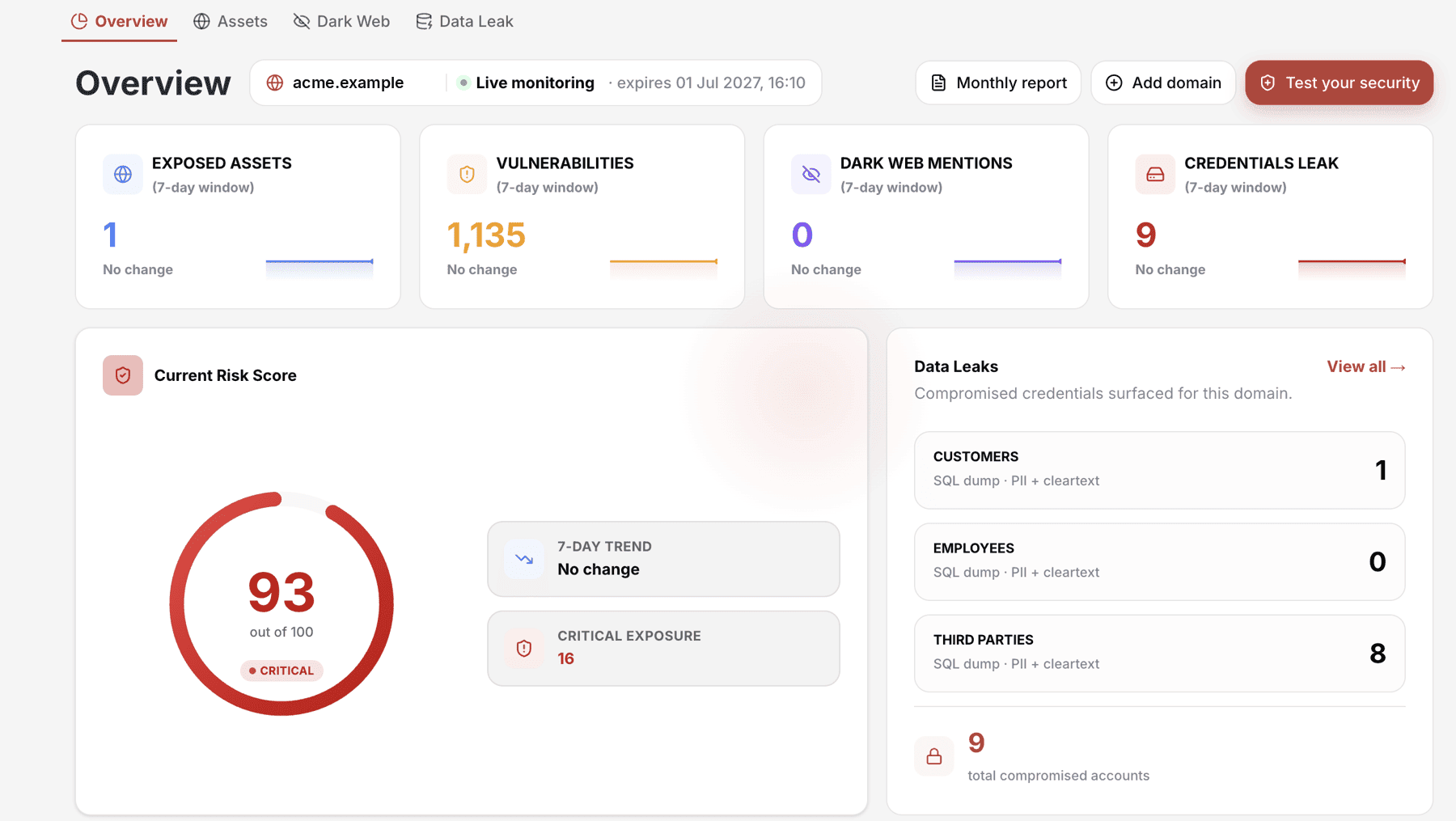
Your attack surface, scored and watched continuously, worldwide. Every domain carries a live risk score, and leaked credentials are broken out by who they actually expose — customers, employees, third parties — not just matched to a breach list.
01
Discover
Map assets, subdomains and exposure as they appear.
02
Score
Roll exposure, vulnerabilities and leaks into one live risk score, 0–100.
03
Validate
Re-check findings and exposed credentials against the live environment.
04
Monitor
Keep the outside view current, worldwide, between assessments.
ReconPulse live dashboard (demo domain) showing exposed assets, vulnerabilities, dark web mentions, credentials leak count, a critical risk score of 93, and a breakdown of leaked customer, employee and third-party credentials
ReconPulse — live risk score and data-leak breakdown, monitored continuously. Domain replaced with a demo tenant for publication.
prove

RedEngine

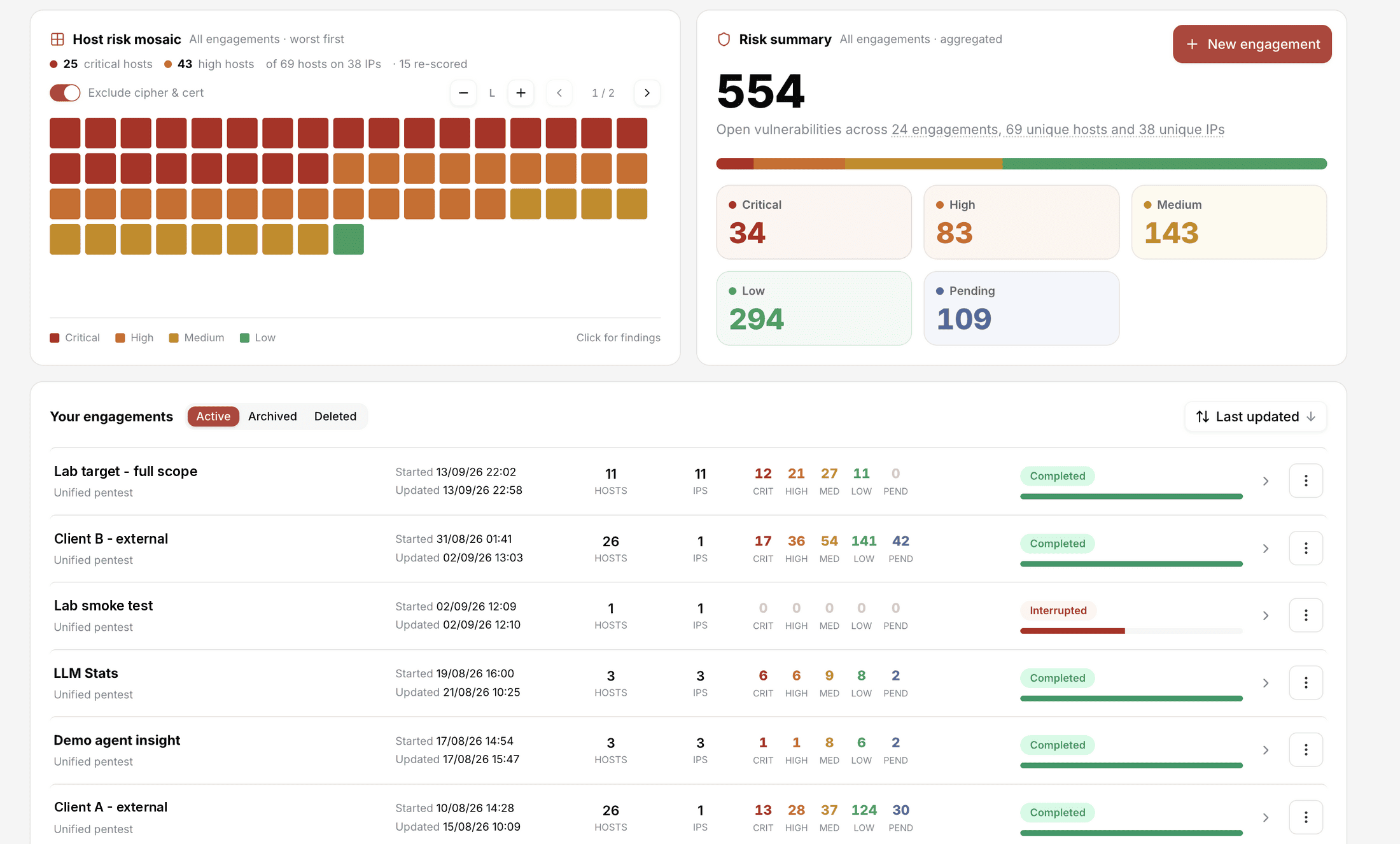
Findings that prove themselves. Every host across every engagement lands on a risk-scored mosaic, rolled up into one live view of what's critical, what's fixed and what's still open — and every finding keeps the exact steps that demonstrated it, plus an AI-generated briefing you can hand straight to the team that has to fix it.
01
Fingerprint
Identify the exposed service across the confirmed scope.
02
Prove access
Demonstrate the condition step by step — command, then output.
03
Confirm blast radius
Show what the access actually reaches, not just that it exists.
04
Fix & re-test
Hand the team an AI-generated fix briefing, then replay the same validation after the fix ships.
RedEngine dashboard showing a host risk mosaic across 69 hosts, a risk summary of 554 open vulnerabilities across 24 engagements, and a list of active engagements with per-severity counts and status
RedEngine — live host risk mosaic and risk summary across a real portfolio of engagements. Engagement names anonymised.
A RedEngine feature · Pentest Studio

Pentest Studio is RedEngine's own operator console. Open any finding straight into it — same target, same evidence, same engagement history carried forward. Replay a step, push a follow-up scan, or read the full command trace without re-explaining anything.
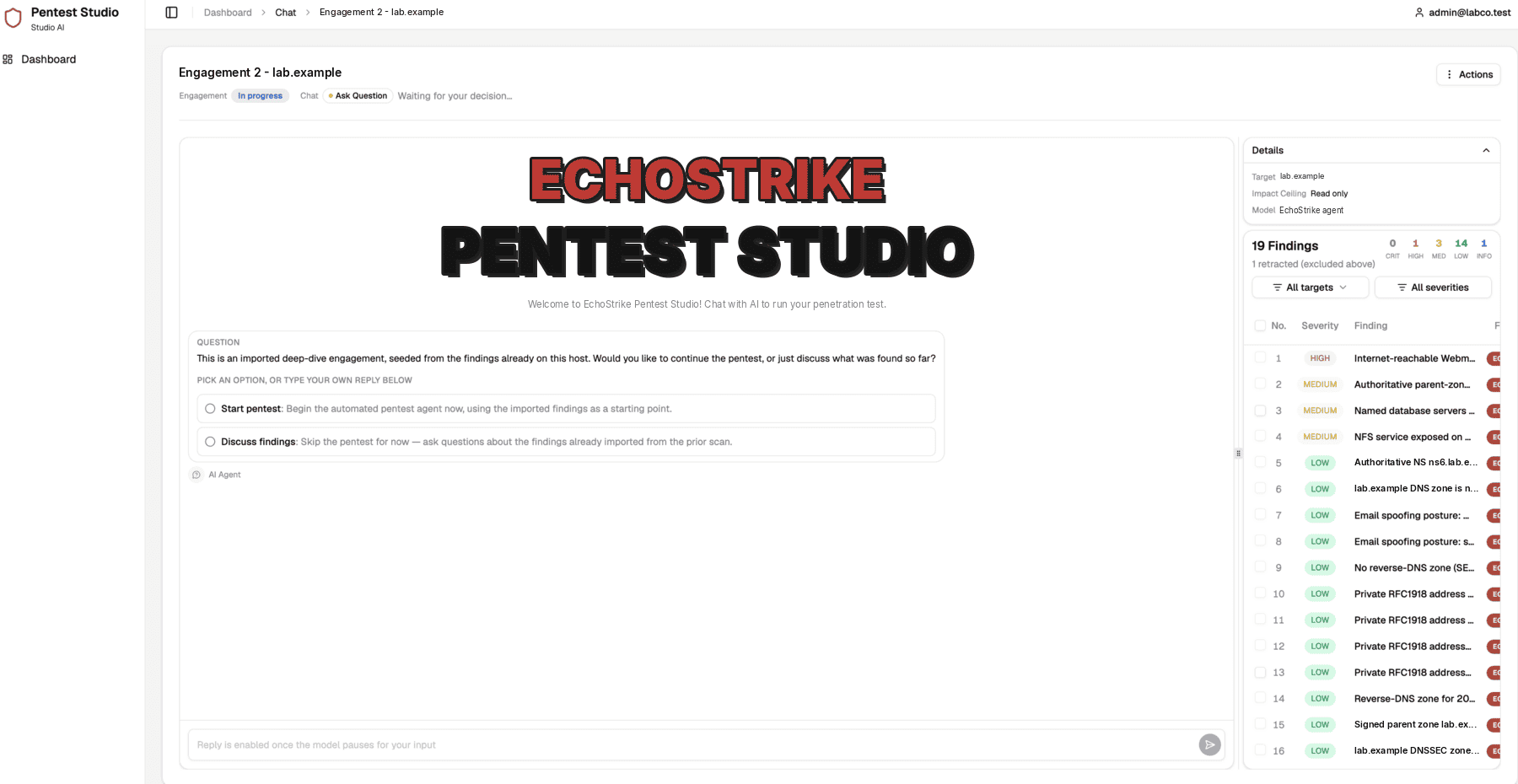
Pentest Studio live operator console mid-engagement, showing an imported deep-dive engagement with 19 findings and an AI agent awaiting a decision
Pentest Studio — RedEngine's live operator console, mid-engagement. Target anonymised.
A RedEngine feature · Attack map & blast radius

A severity score tells you how bad. This shows you where — every port, service and endpoint reachable from the same evidence, traced all the way to the finding it produces, so a fix can be scoped correctly.
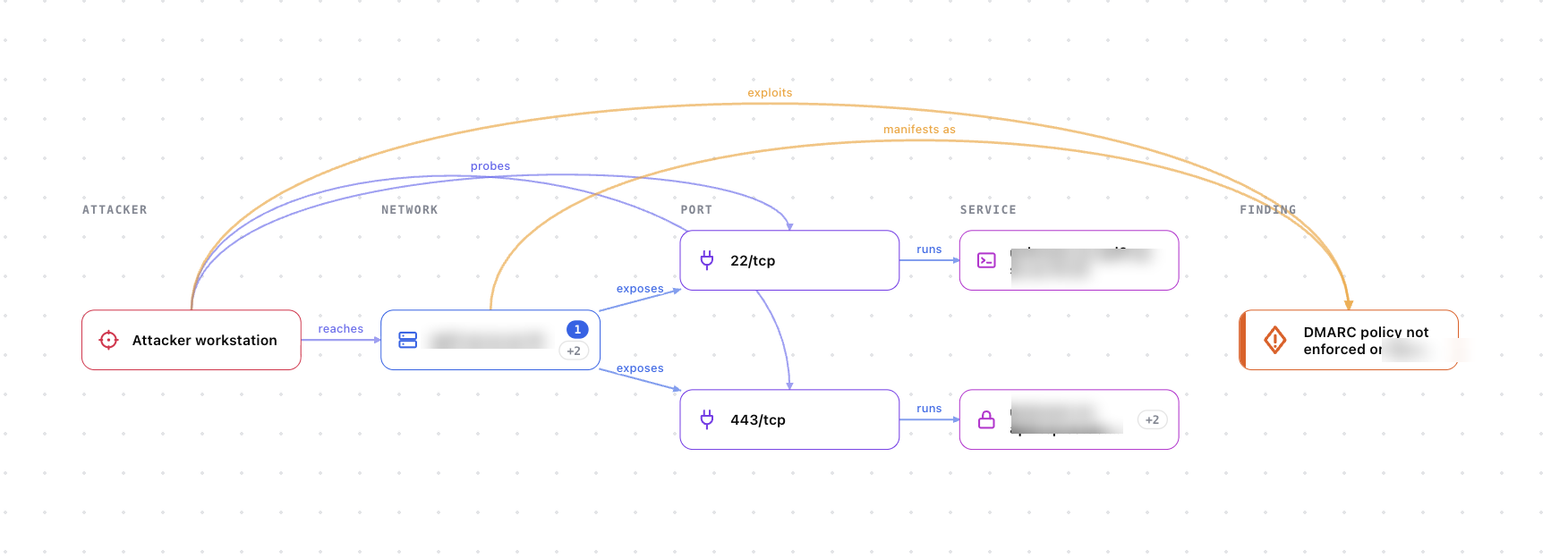
EchoStrike attack map: attacker workstation reaching a target host across two exposed ports and their services, traced to a confirmed DMARC policy misconfiguration. Host and service names redacted for this lab example.
Attack map & blast radius — a live RedEngine trace from attacker workstation, across exposed ports and services, through to the finding. Host and service names redacted.
fix · verified remediation in development

BlueFence

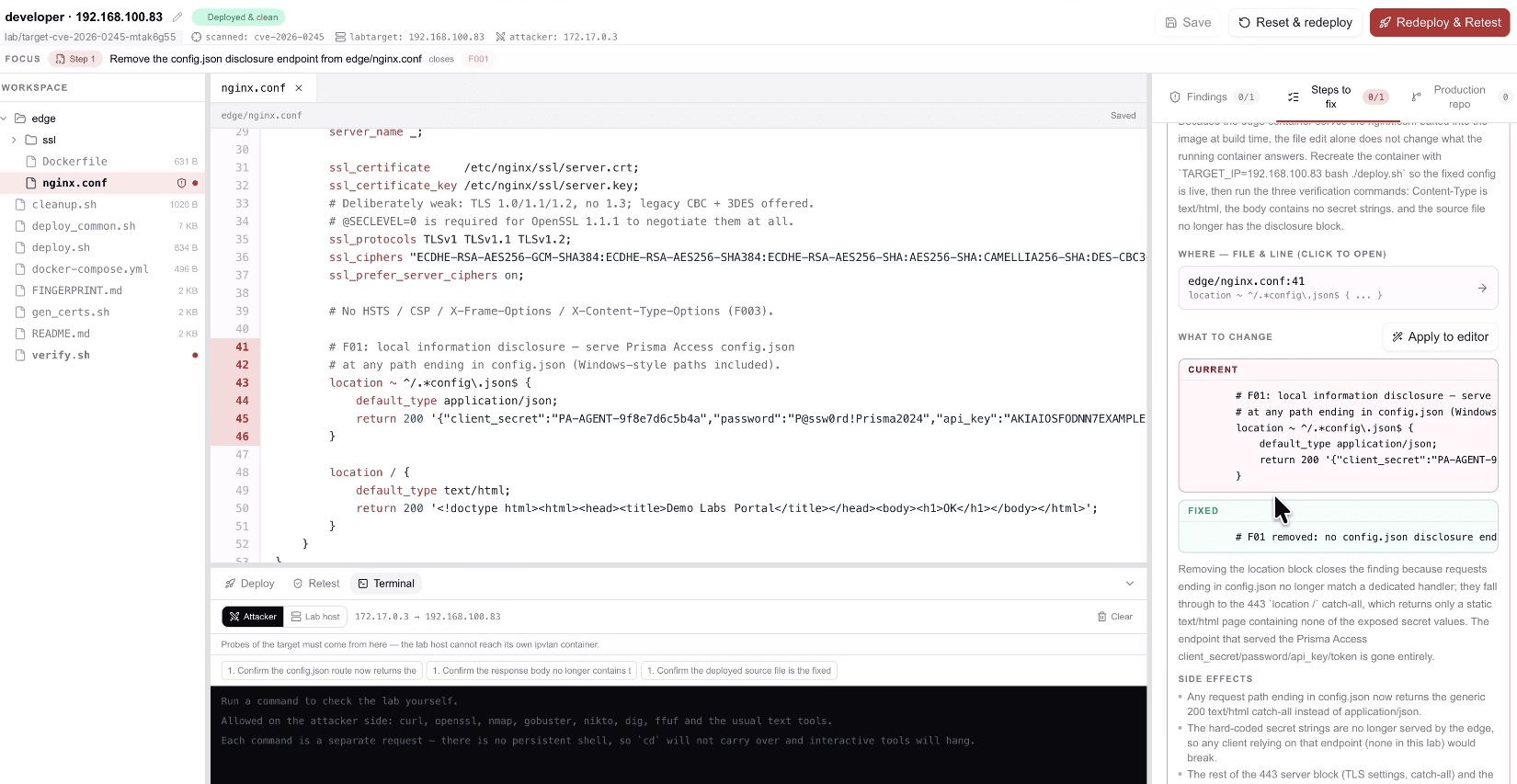
BlueFence closes the loop by re-running the attack that proved the finding — inside a digital twin, not production. The control model checks both sides: the attack fails while the service still responds normally.
01
Digital twin for cyber security
A safe, evidence-linked replica of the target environment, where a fix is proven before it ever touches production.
02
Reuse proven evidence
Receive typed evidence and replay steps from RedEngine.
03
Test the fix
Run the original validation against the remediated target.
04
Verify closure
Confirm the attack fails without mistaking downtime for success.
BlueFence finding on a digital-twin lab target: an nginx config serving a hard-coded client secret, password and API key at a config.json disclosure endpoint, alongside the recommended fix, the exact file and line it changes, and the side effects of applying it
BlueFence — a real finding on a digital twin: the leaking config, the fix, and exactly what changes (and what doesn't) if you apply it.
learns · proprietary

Gets smarter with every engagement

Underneath ReconPulse and RedEngine sits Crimson Nexus, EchoStrike's self-improving knowledge base. Every engagement compounds intelligence, so each subsequent test starts faster, digs deeper and reasons better than the last.


●
Crimson Nexus
Crimson for the confirmed, critical findings it holds; Nexus for the hub where they converge and compound with every engagement.
●
Cyber reasoning genome
The investigation strategies that actually worked, learned across engagements.
●
Next: causal reasoning with ATVE (research)
Understanding why an environment behaves as it does, and deciding what to investigate next. See the research.
CRIMSON NEXUS Raw engagement data Compounded reasoning
references
True RSM Department of Science Service

Trusted by enterprise, professional-services and public-sector teams in Thailand.

What a one-time test would have missed.

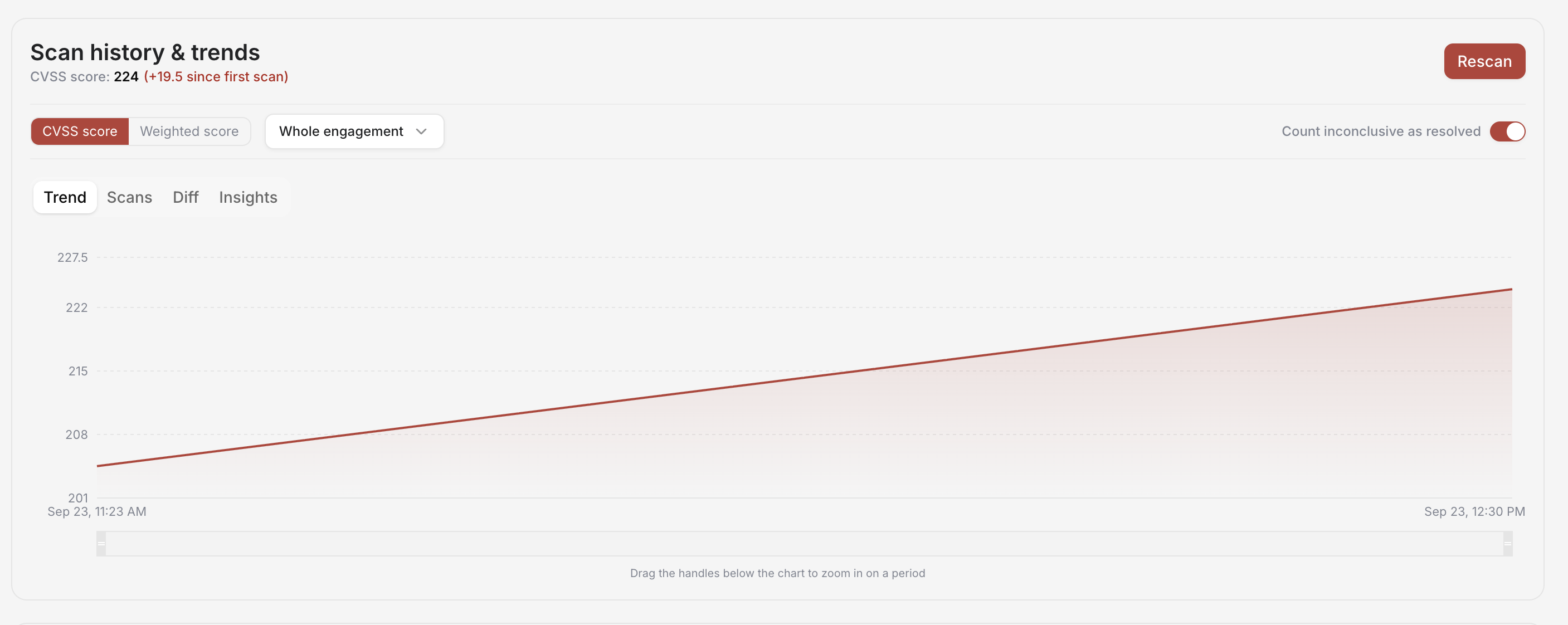
A single scan tells you what's visible today. Continuous validation keeps going. In this engagement, repeated RedEngine passes kept confirming exposure the first pass hadn't reached — adding 19.5 points of confirmed CVSS exposure within the same engagement. A one-off assessment would have closed the book after scan one.
30,000+network elements scanned by RedEngine to date
EchoStrike scan history and trends panel: confirmed CVSS exposure growing by 19.5 points to 224 across repeated scans within a single engagement
Scan history & trends — the same engagement, validated continuously rather than once.
how it compares

Where the coverage actually comes from

Traditional pentestScannerAI-assisted toolEchoStrike
Continuous testing
Real exploit validationpartial
Fail-closed evidence gates (can refuse a finding)manualbuilt in
Attack-path & blast-radius contextmanualvariesbuilt in
Human expert oversightvaries
Re-test on demandmanual
Verified remediation (digital twin proves the fix)manualin development
Reasoning that compounds over timebuilt in
safe by design

Offensive power, engineered restraint.

Autonomous offensive tooling needs explicit boundaries. EchoStrike's operating model centers authorization, scope enforcement and human intervention wherever judgment is required.

Scope enforcement

Operate inside authorized boundaries and exclude out-of-scope assets by design.

Non-destructive by default

Agree exploitation depth before testing starts and gather proof without unnecessary disruption.

Human authorization gate

Escalate high-judgment actions and ambiguous evidence to an accredited expert.

Segregated engagement data

Keep client engagement data isolated while learning from higher-level patterns.

built for enterprise

Fits how security teams actually operate.

Technology is only half the procurement conversation. EchoStrike is built to slot into existing operations, not replace them.

Flexible deployment

Run continuous or scheduled validation against internal or external attack surface, on the cadence your operations calendar allows.

API-ready workflows

Findings and evidence are available via API, ready to flow into the ticketing and remediation systems you already use.

Compliance-ready evidence

Every finding keeps its full evidence chain and sign-off history, exportable in the format your audit workflows expect.

A named engagement lead

Every deployment has an accountable human point of contact for scope changes, escalations and sign-off.

beyond today's platform — ATVE research

Autonomy that has to prove itself.

The research frontier is not more automation. It is autonomy that stays within agreed limits, acts only on evidence, and leaves a record an auditor can check. The platform already refuses unproven findings and re-tests on demand; ATVE is the research into measuring and governing the rest.

Provably bounded autonomy Deterministic scope Calibrated trust Re-executable evidence
the team

Decades of offensive security, now built into software.

Offensive-security operators, a PhD-led AI research team and seasoned security leaders, working from Bangkok and Oxford. The expertise that once came only as a consulting engagement now runs continuously in EchoStrike.

30,000+network elements tested
15+CVEs discovered
150+security projects delivered
60+years combined experience
ISO 27001:2022 certified ISO 9001:2015 certified Oxford Science Park research Offices in Oxford & Bangkok
Meet the full team →
get started

Find it. Prove it. Fix it.

Bring your attack surface, testing cadence and remediation problem. We'll show you how EchoStrike finds, proves and helps fix what attackers can actually reach — in your real operating environment.